






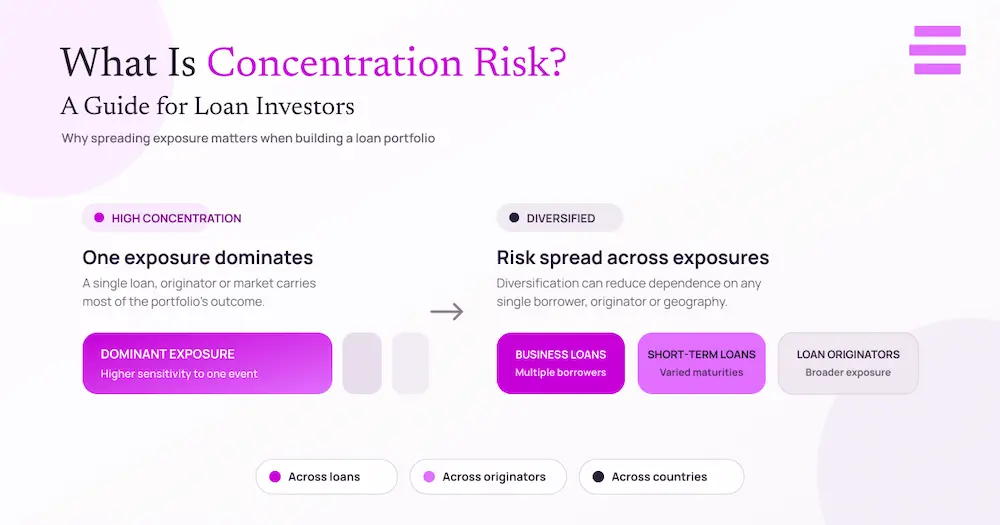
Concentration risk is the risk that too much of a portfolio depends on one loan, borrower, loan originator, or market, so a single problem can cause an outsized loss. The more a portfolio leans on one source of repayment, the harder one setback hits.
It matters in loan investing because each position is a single contract with its own borrower, and a missed repayment affects that position in full. This guide explains where concentration comes from and how to reduce it.
Concentration Risk Meaning
Concentration is about how exposure is spread across a portfolio, rather than how risky any single loan is. A portfolio of carefully chosen loans can still be highly concentrated if they all depend on the same company or economy.
Concentration is also easy to miss, because exposures that look different on paper can share the same driver. Loans to different borrowers may all depend on one originator collecting repayments, or on one economy staying healthy. Looking at what each position ultimately relies on gives a truer picture than counting positions.
The general meaning of concentration risk is well established. FINRA, the US financial industry body focused on investor protection, describes it as the risk of amplified losses from holding a large share of a portfolio in one investment, asset class, or market segment.
Concentration risk differs from credit risk. Credit risk is the chance that one borrower fails to repay, while concentration risk describes how much that failure, or several related ones, would affect the whole portfolio.
It also differs from liquidity risk, which concerns whether an investor can exit an investment when they need the money.
Concentration does not cause a loss on its own. It increases how much a single event can affect the portfolio when something goes wrong. Diversification means spreading exposure across different investments, reducing reliance on any one of them without removing risk.
Where Does Concentration Risk Come From in Loan Investing?
Concentration risk in loan investing can come from several sources, and a portfolio may be exposed to more than one of them at the same time.
A single loan or borrower. The simplest form is a large share of the portfolio sitting in one position. If that borrower stops paying, a big part of the portfolio stops earning at once.
The loan originator. Loans issued by the same loan originator may share its financial health. If the originator runs into difficulties, many loans can be affected together, even when their borrowers have nothing in common.
Country or market. Loans made in the same economy may respond to the same conditions, such as rising unemployment or higher interest rates. A downturn in one country can then reach many borrowers at once.
Loan type or term. Similar products, such as short-term consumer loans, may behave alike under stress. Loans with similar maturities can also cluster repayments, so money comes back in large batches instead of steadily.
Reinvestment. Automatic or repeated reinvestment can build exposure without the investor noticing. If the same settings keep selecting similar loans, a portfolio can drift towards one originator or market over time.
Exposure to the platform itself is a separate question, covered in what happens if a P2P platform goes bankrupt.
Example: How Concentration Can Affect a Portfolio
This example is hypothetical and uses round figures. It does not show a typical or expected outcome, and spreading investments does not prevent loss. Each portfolio invests €1,000.
| Portfolio | How the €1,000 is invested | If one loan stops repaying | If one originator runs into difficulties |
| A | One loan of €1,000 | €1,000 affected | €1,000 could be affected |
| B | Ten loans of €100, from ten different originators | €100 affected | €100 could be affected |
| C | Ten loans of €100, all from the same originator | €100 affected | Up to €1,000 could be affected |
Portfolios B and C look the same by loan count, and both limit the damage from one failed loan. The difference appears when the originator itself struggles: C has spread its money across loans, yet every loan still depends on the same company. Spreading across loans is therefore not the same as spreading exposure.
The same logic applies to countries and loan types. Ten loans from ten originators can still be concentrated if every originator lends in the same country, because a local downturn can hit them all at once.
How Can Investors Reduce Concentration Risk?
Investors can reduce concentration risk by spreading exposure across loans, originators, countries, loan types, and terms. Reducing concentration risk starts with understanding where exposure sits today, so a periodic look at how much of the portfolio depends on each originator or market shows whether it has drifted.
Reinvestment settings deserve the same attention. When repayments reinvest automatically, checking the criteria periodically helps ensure new money doesn’t keep flowing into the same place.
A portfolio also changes shape as loans repay. Shorter loans finish first, so the remaining money can end up weighted toward longer loans or a smaller group of originators than at the start. Reviewing the mix after large repayments helps spot this.
Adjusting usually happens through new investments rather than selling existing ones. Directing fresh money or reinvested repayments towards under-represented originators, countries, or terms shifts the balance gradually, which matters because liquidity may be limited if an investor tries to sell positions early.
Investors can also set their own limits, such as a maximum amount per loan or originator. The right level depends on each investor’s situation, so no single figure suits everyone. Platforms offer different tools; on Hive5, how investing on Hive5 works explains the process.
Spreading exposure has trade-offs. A diversified portfolio has more positions to monitor, and related exposures can still move together, for example, when loans from different originators in the same country all suffer in one downturn.
Diversification can reduce concentration risk in P2P lending, but it can’t eliminate it. Diversification may reduce reliance on a single exposure, yet it does not remove the risk of capital loss or guarantee returns.
How Does Concentration Risk Apply to Hive5?
Hive5 is a loan investment marketplace where investors acquire claim rights to already-issued loans offered by loan originators. Investments start at €10, allowing smaller amounts to be spread across several loans.
Investors can spread exposure using Auto-Invest, which invests automatically based on the settings the investor selects and confirms, or Manual Invest, where investors choose each loan individually.
Spreading investments does not remove risk. As Hive5’s Transparency Update states, “The decision to issue the loan is made by the relevant Loan Originator, not by Hive5.” The same update encourages investors to “carefully assess these risks and diversify their exposure.”[FM5]
Acquiring loan claim rights involves risk. Investors can lose part or all of their capital, payments may be delayed, or borrowers may default, and loan originators may face financial difficulties. Liquidity may be limited, and deposit guarantee schemes or capital protection may not cover loan claim rights. Hive5’s Transparency Hub sets out the marketplace model and its risks in more detail.
To compare loans and their originators before investing, explore the Hive5 loan investment marketplace.
Frequently Asked Questions
There is no fixed number of loans that avoids concentration risk. How exposure is spread across originators, countries, loan types, and terms matters more than the count, and holding more loans does not remove risk.
No. Credit risk concerns whether an individual borrower repays, while concentration risk concerns how much one failure, or several linked ones, would affect the portfolio as a whole.
No. Diversification may reduce reliance on any one loan, originator, or market, but credit risk, liquidity risk and other risks still apply.
Yes. Automatic reinvestment or repeated similar choices can steer new money toward the same originator or market over time, so periodic portfolio reviews help catch that drift early.