








About this guide: Hive5 created this guide to help you compare online lending models. Hive5 operates a marketplace for claims on loans that lending companies have already issued. We explain that distinction below, alongside the risks and questions to consider when comparing platforms.
In this guide: What is crowdlending · How it works · Types of crowdlending · Crowdlending vs crowdfunding vs P2P lending · Returns · Risks · Regulation · How to choose a platform · How Hive5 differs from crowdlending · First steps · FAQ
What is crowdlending?
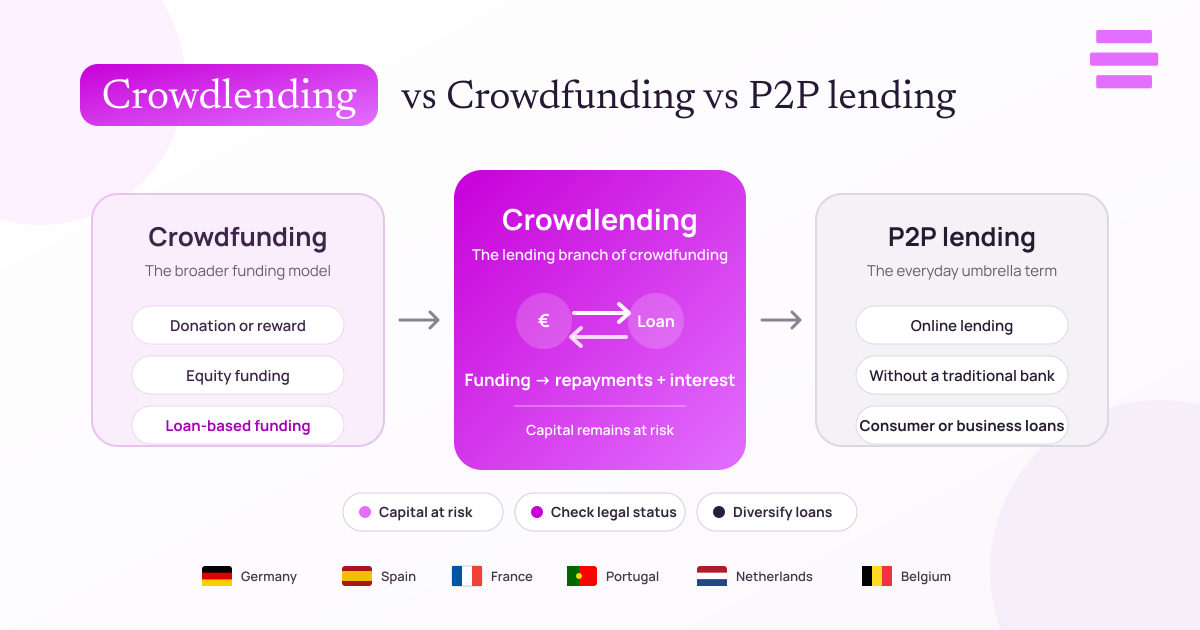
Crowdlending is the lending branch of crowdfunding: instead of donating money or buying shares, the crowd lends money and expects it back with interest. The word combines “crowd” and “lending”.
A crowdlending platform sits between two groups:
- Borrowers who want finance outside a traditional bank. Most are small and medium-sized businesses (SMEs) needing working capital or growth funding. Some platforms also finance property developers or individual consumers.
- Lenders, usually called investors, who fund part of a loan, often from as little as €10 to €100, and receive their share of the repayments.
The platform checks borrowers, publishes the loan terms, collects investors’ money, passes repayments back and handles what happens if a borrower falls behind. In return, it earns fees from borrowers, investors or both.
Crowdlending grew after the 2008 financial crisis, when banks cut lending to smaller businesses and online platforms stepped in. Since November 2021, the EU has had its own rulebook for it, covered in the regulation section below.
How does crowdlending work?
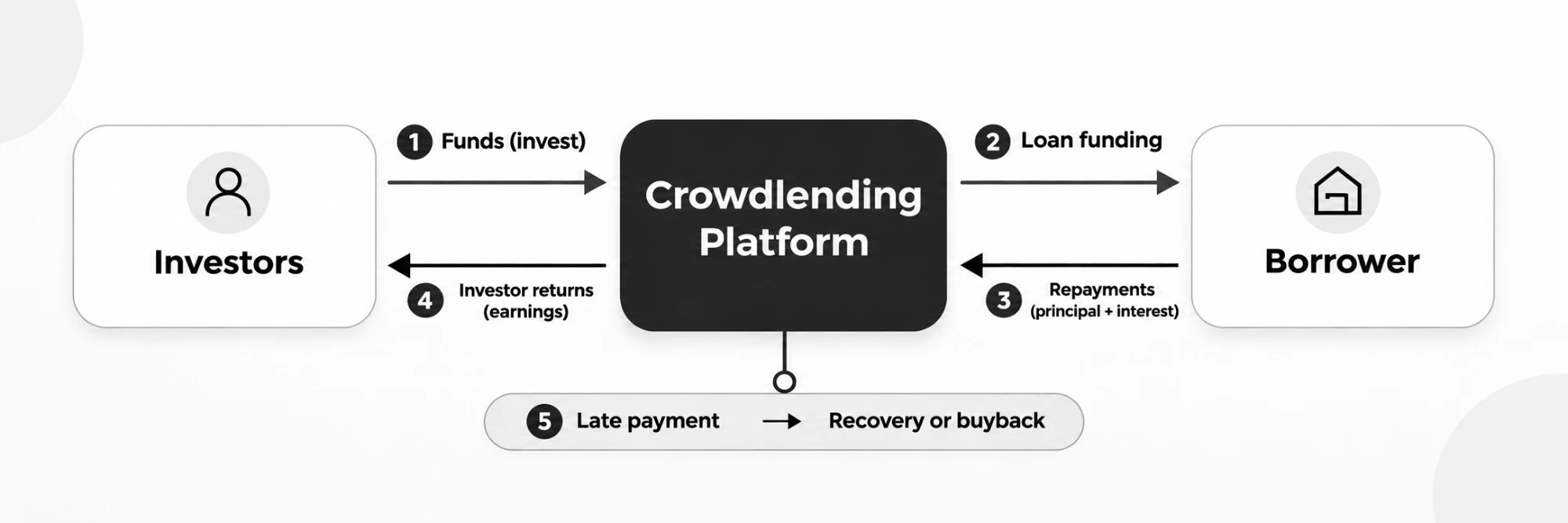
Crowdlending works in five steps, from a borrower’s application until the final repayment. Peer-to-peer lending also follows this pattern.
- Application and credit check. A borrower applies to the platform. The platform (or a partner lender) assesses creditworthiness, financial history and any collateral, then sets an interest rate that reflects the risk.
- Listing. The platform then publishes the approved loan’s amount, interest rate, term, repayment schedule and risk information.
- Funding. Investors choose loans and commit money. Once investors contribute enough money, the loan reaches its funding target; some platforms let investors automate this with an auto-invest tool.
- Repayment. The borrower repays in instalments or at the end of the term. The platform passes each investor’s share of principal and interest to their account.
- Maturity or default. If the borrower meets every payment, investors receive the full amount due. If the borrower stops paying, the platform starts a recovery process. That may mean collection, enforcement of collateral or a contractual protection such as a buyback. Investors may then get back part, all or none of what the borrower owes them.
Types of crowdlending
Crowdlending comes in four main types, depending on who borrows and what, if anything, backs the loan.
1. Business crowdlending (P2B)
Business crowdlending, also called peer-to-business lending, funds SMEs for working capital, equipment or expansion. Loans usually run from a few months to five years, and some come with a personal or company guarantee.
2. Consumer crowdlending (P2P)
Consumer crowdlending funds personal loans to individuals, such as instalment or short-term credit. Interest rates are often higher because individual borrowers are harder to assess and collateral is rare.
3. Property-backed crowdlending
Property-backed crowdlending funds developers or property owners, typically backed by a mortgage over the property. The number to watch is the loan-to-value (LTV) ratio: the lower it is, the bigger the cushion if it comes to a forced sale.
4. Invoice and short-term finance
Invoice finance lets a business borrow against invoices before its customers pay them. Terms are short, often 30 to 120 days, because the business repays when its customer pays the invoice.
Crowdlending vs crowdfunding vs P2P lending
Crowdlending is one type of crowdfunding, and people often use P2P lending as a near-synonym. A fourth model, the loan-claims marketplace, is common in Europe but easy to confuse with the others.
| Donation or reward crowdfunding | Equity crowdfunding | Crowdlending (loan-based crowdfunding) | P2P lending | Loan-claims marketplace | |
|---|---|---|---|---|---|
| What you get | A thank-you or a product | Shares in a company | A share of a loan, repaid with interest | A share of a loan, repaid with interest | Contractual rights to repayments on a loan already issued by a lending company |
| Who issues the loan | No loan | No loan | Investors fund a new loan through the platform | Investors fund a new loan through the platform | A lending company issues and funds it first, then offers the claim to investors |
| Where the return comes from | No financial return | Dividends or sale of shares | Borrower’s interest | Borrower’s interest | Interest set in your agreement, paid by the lending company from borrower repayments |
| Typical protection | None | None | Collateral or guarantees, depending on the loan | Collateral, guarantees or provision funds, depending on the platform | Often a buyback obligation by the lending company |
| EU regulation | Not covered by ECSP | ECSP (if offered via a crowdfunding platform) | ECSP authorisation required | Usually ECSP (business loans); consumer P2P depends on national rules | Outside ECSP, because the platform does not arrange or fund new loans; the legal basis depends on the model and the country |
What is peer-to-peer lending?
Peer-to-peer (P2P) lending is lending between individuals, or from individuals to businesses, arranged online without a bank in the middle. In everyday use, “P2P lending” and “crowdlending” mean much the same thing. In regulation they can differ: the EU’s ECSP Regulation covers loans to businesses, while national rules govern consumer P2P lending. For how P2P lending compares with shares and savings, read P2P lending vs traditional investing.
What returns can crowdlending offer?
Crowdlending returns come from the interest borrowers pay, and the rate reflects how risky the loan is. So higher advertised rates usually mean riskier borrowers, shorter track records or weaker collateral.
However, the advertised interest rate does not tell you what you will actually earn. Three factors shape your net return:
- Interest rate and term. Each loan’s rate sets what you earn, and its term sets how long your money stays locked in.
- Losses and delays. Defaults, late payments and recovery costs can reduce your net return. As a result, a high headline rate can turn into a low or negative real return.
- Fees and tax. Some platforms also charge investors fees. In addition, each country taxes investment income differently. Germany, Spain, France, Portugal and Belgium generally tax interest as investment income, while the Netherlands currently taxes savings and investments mainly through Box 3. Some countries also withhold tax at source, so check your local rules or speak to a tax adviser.
Compare platforms on net returns after losses over several years, not on the highest rate advertised today.
What are the risks of crowdlending?
The main risks of crowdlending, and of P2P lending generally, are that borrowers do not repay, that you cannot exit when you want and that the platform or its partners run into trouble. You cannot remove these risks completely, but you can reduce each one.
1. Credit risk (default)
Credit risk is the chance that a borrower pays late or not at all.
How to reduce it: spread your money across many loans, check the platform’s historical default and recovery rates and understand what protection exists and who pays for it.
2. Liquidity risk
Liquidity risk means you may not be able to get your money back before the loan ends. For example, some platforms offer a secondary market where you can sell loans to other investors, but you may not find a buyer, and you may need to sell at a discount.
How to reduce it: only invest money you will not need during the loan term.
3. Platform risk
Platform risk is the chance that the platform itself fails, makes errors or mishandles client money.
How to reduce it: check whether the platform keeps uninvested money separate from its own funds, read the audited accounts and find out what happens to your loans if the platform closes.
4. Concentration and related-party risk
Concentration risk arises when much of your money depends on one borrower, one lending company or one group. For example, if all your loans come from companies in one group, trouble in that group can hit every loan at once. So spreading money across those loans does not remove group risk.
How to reduce it: check who owns the lending companies, spread across different originators where possible and read each company’s financial reports.
5. Protection risk
A buyback obligation (sometimes marketed as a buyback guarantee) or any other guarantee is only as strong as the company that gives it. So if that company struggles, it may not be able to honour the promise.
How to reduce it: treat any protection as a promise from a named company, not as a guarantee of your capital.
6. Regulatory and legal risk
Rules for crowdlending and loan marketplaces differ between countries and can change. A platform’s legal status also decides what protections you have.
How to reduce it: check the platform’s legal status. A licensed platform comes with regulator oversight and rules such as ECSP’s investor protections. No financial regulator supervises a platform whose model needs no licence, so read its agreements, legal basis and published legal opinions.
Is crowdlending regulated?
Across the EU, crowdlending to businesses falls under the European Crowdfunding Service Providers Regulation (ECSP), Regulation (EU) 2020/1503. It has applied since 10 November 2021, and its transition period ended on 10 November 2023.
Under ECSP, a crowdlending platform needs authorisation from a national regulator in its home country, such as BaFin in Germany, the CNMV in Spain, the AMF in France, the CMVM in Portugal, the AFM in the Netherlands or the FSMA in Belgium. Once authorised, it can offer its services across the EU. The European Securities and Markets Authority (ESMA) also keeps a public register of authorised crowdfunding service providers.
Investor protections under ECSP
For investors without professional experience (“non-sophisticated investors”), ECSP adds protections:
- an entry knowledge test before investing
- a key investment information sheet (KIIS) for each offer
- a four-day reflection period during which you can withdraw an offer to invest without penalty
- a risk warning, and your explicit consent, when you invest more than the higher of €1,000 or 5% of your net worth in a single offer
Which lending models fall outside ECSP?
ECSP covers loans to businesses but not loans to consumers. Consumer lending platforms and marketplaces where investors buy claims on loans that lending companies have already issued generally fall outside ECSP’s scope. Whether any other licence applies depends on the model and the country. This is why P2P lending in Europe sits under a patchwork of EU and national rules, and “P2P” in a platform’s name does not tell you whether a regulator has authorised it.
How to check a crowdlending platform’s authorisation
ECSP is the same in every EU country, but each country has its own national competent authority, which authorises local platforms and publishes investor guidance in the local language.
| Country | National authority for crowdfunding | What to check there |
|---|---|---|
| Germany | BaFin (Bundesanstalt für Finanzdienstleistungsaufsicht) | Company database and investor warnings |
| Spain | CNMV (Comisión Nacional del Mercado de Valores) | Register of crowdfunding service providers and warnings about unauthorised entities |
| France | AMF (Autorité des marchés financiers) | Authorised providers and its blacklists of unauthorised investment offers |
| Portugal | CMVM (Comissão do Mercado de Valores Mobiliários) | Supervised entities and investor alerts |
| Netherlands | AFM (Autoriteit Financiële Markten) | Public register and warnings |
| Belgium | FSMA (Financial Services and Markets Authority) | Lists of authorised providers and warnings about fraudulent offers |
A platform authorised in one of these countries can serve investors in the others, so the platform’s home regulator may not be your own.
If a platform says it holds authorisation as a crowdfunding service provider, search its legal name on the ESMA register or its national regulator’s register and read what the authorisation covers. If it operates outside licensing, as loan-claims marketplaces typically do, read its legal-status page and any legal opinions it publishes.
How to choose a crowdlending or P2P platform
Before comparing interest rates, ask each platform the same eight questions. Good platforms answer them clearly on their own website.
- What is its legal status? A platform that arranges new loans to businesses in the EU needs ECSP authorisation, which you can check on the ESMA register. A marketplace selling claims on existing loans may not need a licence; read its stated legal basis and any legal opinions it publishes.
- Who issues the loans? The platform itself, independent lenders or companies in the same group?
- What exactly do I own? A share of a loan, a note or a contractual claim on repayments?
- What protection exists and who provides it? Collateral, a guarantee, a buyback obligation or a provision fund, and which company stands behind it?
- Does it publish audited accounts? For the platform and for any lending companies.
- Does it keep my uninvested money separate from the company’s own funds?
- What happens if the platform closes? Is there a back-up servicing arrangement?
- Can I exit early? Is there a secondary market and on what terms?
When a platform makes these answers hard to find, treat that as a warning sign.
How Hive5 differs from crowdlending
Hive5 is not a crowdlending platform. Instead, it is a P2P marketplace where investors acquire claim rights on loans that lending companies have already issued and funded. Because Hive5 does not issue loans, arrange new loans or raise money for projects, its model does not require a financial services licence.
How Hive5 answers the eight questions
| Question | Hive5’s answer |
|---|---|
| What is its legal status? | Hive5 marketplace d.o.o. is a Croatian company. Its registered office is in Zagreb. It holds no financial services licence because its marketplace model does not require one. In 2024, a Croatian law firm concluded that its activities need no licence from the Croatian authorities, and a Lithuanian law firm reached the same conclusion. A 2026 review by Babić & Partners concluded that Hive5 needs no e-money licence. Read Hive5’s regulatory status and the legal opinion on Hive5’s legal status. |
| Who issues the loans? | Lending companies owned by Hive Finance Group: Credilink (consumer credit lines, Romania), Firmeo (SME loans, Poland) and FinJet (short-term consumer loans, Spain). |
| What do I own? | Contractual claim rights to repayments under an Investment Agreement that names the borrower, the lending company and the payment terms. |
| What protection exists? | A buyback obligation: if a payment is more than 60 calendar days overdue, the lending company must repurchase the claim with accrued interest. A group guarantee also applies. However, both depend on the lending companies’ and the group’s ability to pay. Hive5 investments are not bank deposits, and no deposit guarantee or investor compensation scheme covers them. See the main risks of investing on Hive5. |
| Audited accounts? | Hive5 publishes the group’s accounts, with independent audit findings, in the Transparency Hub. |
| Uninvested money kept separate? | Yes. Uninvested funds sit in a separate account, segregated from Hive5’s own funds. |
| If the platform closes? | Hive5 acts as an intermediary. If Hive5 became insolvent, the legal relationships under existing investments would continue under the applicable agreements. |
| Exit early? | A secondary market lets investors list investments before maturity. However, a sale depends on a buyer. |
Related-party and concentration risk on Hive5
Hive5’s model concentrates exposure in one group: the companies that issue the loans and provide the buyback belong to the same group as the marketplace. Because no financial regulator supervises Hive5, the documents it publishes (Investment Agreements, legal opinions and audited group accounts) are your main tools for due diligence. Hive5 marketplace d.o.o. in Zagreb, Croatia, runs Hive5, and Hive Finance Group (Hive Finance UAB, Vilnius, Lithuania) owns it.
Where to find investor reviews
Hive5 passed 500 reviews on Trustpilot in October 2026. You can read every review, positive and negative, on Hive5’s Trustpilot page. For longer accounts of how individual investors use the platform, see Hive5 investor testimonials.
Read how Hive5 works and manages risk
How to get started with crowdlending (sensibly)
Decide your limits before you compare interest rates or put money into a loan.
- Set an amount you can afford to lose and money you will not need for the length of the loans.
- Shortlist platforms using the eight questions above, then read their legal and risk pages.
- Start small. Many platforms, including Hive5, accept investments from €10, so you can learn how repayments and delays work before committing more.
- Diversify across many loans, loan types, countries and, where possible, lending companies and platforms, so a single default hurts less.
- Finally, review regularly. Track late payments and recoveries, and decide on purpose whether to reinvest repayments or withdraw them.
Frequently asked questions about crowdlending
Is crowdlending safe?
Crowdlending is not risk-free. Borrowers can default, protections depend on the company providing them and you may not be able to exit early. Risk is lower when you diversify widely, use authorised or transparent platforms and invest only money you can afford to lose.
Can you lose money in crowdlending?
Yes. If a borrower stops paying and recovery or any buyback fails, you can lose part or all of the money lent. Platform failure, fraud or a lending company’s financial trouble can also cause losses.
Is crowdlending the same as P2P lending?
Mostly, in everyday use. Both mean individuals lending money online to borrowers without a bank in between. Regulators can treat them differently: in the EU, crowdlending to businesses falls under ECSP, while consumer P2P lending and loan-claims marketplaces may follow national rules.
Do you have to pay back crowdfunding?
It depends on the type. Donation and reward crowdfunding do not involve loan repayments. By contrast, equity crowdfunding gives investors shares. Crowdlending is a loan, so the borrower must repay the money with interest on the agreed schedule.
Is crowdlending legal in Germany, Spain, France, Portugal, the Netherlands and Belgium?
Yes. In the EU, crowdfunding platforms need authorisation under the ECSP Regulation before they can arrange new loans to businesses. The same EU rules apply in all six countries, while each has its own national authority (BaFin, CNMV, AMF, CMVM, AFM and FSMA) that authorises local platforms. Always check a platform’s register entry or stated legal status before investing.
How much do I need to start crowdlending?
Minimums vary by platform but are typically €10 to a few hundred euros per loan. Starting with a small amount spread over several loans lets you see how repayments and delays work before you commit more.
Is Hive5 a crowdlending platform?
No. Instead, Hive5 is a P2P marketplace where investors acquire claim rights on loans already issued by lending companies in Hive Finance Group, each with a 60-day buyback obligation from the lending company. Because Hive5 does not arrange new loans or raise funds for projects, ECSP does not apply to it, and the legal opinions Hive5 has published conclude that its model needs no financial services licence. Read Hive5’s regulatory status.
What happens if a borrower stops paying?
On a crowdlending platform, the platform normally starts collection or enforces any collateral, and investors receive whatever it recovers. On marketplaces with a buyback obligation, such as Hive5, the lending company must buy back the claim with accrued interest once a payment is more than 60 days overdue, if it is able to.
Crowdlending lets people lend money to businesses or individuals through an online platform. Several investors contribute to a loan, and the borrower agrees to repay it with interest. Also called loan-based crowdfunding or debt crowdfunding, it carries risks: borrowers can miss payments, and investors can lose money.
Capital at risk. Lending money through any online platform can lead to the loss of some or all of your investment. Returns are not guaranteed, and you may not be able to get your money back before a loan ends.


